High-throughput outbound SMTP delivery,
built for serious senders.
A commercially packaged MTA with an included management console, durable queueing, adaptive traffic shaping, and SignalAI advisories — running on your own Linux infrastructure with predictable instance-based licensing.
- Linux, private cloud, or bare metal
- Included WebUI, API, CLI
- Instance-based pricing

Try SignalMTA on your own infrastructure
Tell us what you need and we'll route it to the right place — an evaluation license and sizing review, or the quickstart guide so your team can install today.
We'll scope your sending profile, size the host, and set you up with an evaluation license and a walkthrough of the console.
Modern MTA decisions
Why delivery teams are re-evaluating their MTA
Static policy files slow teams down
Provider behavior changes hour by hour. When throttles, retries, pools, source IPs, and message streams live in scattered static files, teams spend too much time translating symptoms into safe changes.
Visibility gaps slow incident response
High-volume senders need to connect queue state, SMTP replies, DNS behavior, negotiated TLS, source-IP performance, bounce categories, and message streams without waiting for external log reconstruction.
Specialist dependency creates risk
Legacy operational knowledge often lives with a few senior operators. SignalMTA gives newer team members guided views while preserving direct config, CLI, API, and scripting access for experts.
Volume-based pricing compresses margins
When delivery costs rise with every message, platform leaders have less room to price competitively, absorb seasonal peaks, or offer high-volume customers predictable economics.
Why teams choose SignalMTA
Built for operators, not just installed for them.
SignalMTA combines the control expected from a serious message transfer agent with the visibility, guidance, and commercial packaging modern email delivery teams need.
Integrated WebUI
Manage queues, domains, policies, routing, and performance without relying entirely on CLI workflows.
Role-based operating modes
Give CTOs, delivery engineers, and deliverability teams the information most relevant to their responsibilities.
SignalAI advisories
Surface actionable delivery observations without replacing operator control.
Host qualification workflow
Evaluate infrastructure and delivery behavior before committing production traffic.
Queue and domain visibility
Identify where mail is accumulating, slowing, deferring, or failing.
Flexible operating model
Use the WebUI, CLI, API, or configuration files according to the way your team operates.
Commercial packaging
Deploy a supported product with documentation, licensing, upgrade paths, and clear operating guidance.
Infrastructure economics
Understand instance utilization and cost-per-thousand delivery economics from the same operating environment.
Role-based WebUI
The same operating console, tuned for the way each team works.
Focused modes let executives, infrastructure teams, and deliverability specialists work from the same source of truth without drowning in the wrong level of detail.
CTO Mode
Executive infrastructure summaries, throughput trends, system health, cloud utilization, and CPM reporting for AWS, Azure, and Google Cloud-oriented deployments.
Engineer Mode
Operational views for nodes, queues, TLS, DNS, logs, configuration, API health, resource pressure, retries, and deployment readiness.
Deliverability Mode
Focused drill-downs by customer stream, domain, IP pool, campaign, tag, bounce category, complaint signal, warmup stage, and SignalAI recommendation.
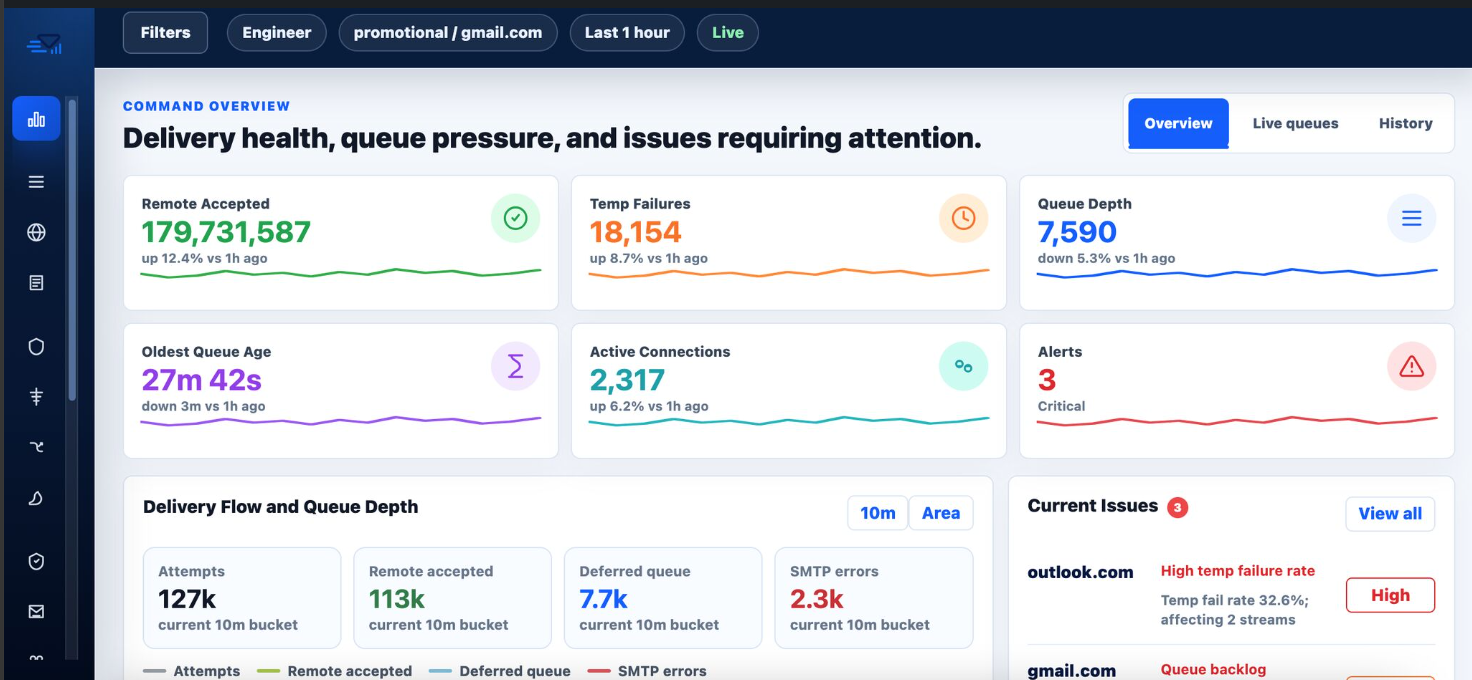
Command Overview — delivery health, queue pressure, and issues requiring attention.
Performance + insight
in one operating experience.
- Real-time diagnostics
- Spot issues as they happen with live signals across queues, IPs, domains, and streams, then expand the same scope from minutes to months.
- Delivery intelligence
- Understand what drives performance with actionable metrics and trend context.
- Operational clarity
- Unified dashboards, preserved drilldown filters, and clean time-windowed data help your team act faster with confidence.

Built for teams where email delivery is mission-critical
ESPs
Power reliable delivery for customer traffic at scale.
SaaS platforms
Integrate email delivery that grows with your product.
High-volume senders
Move more accepted recipients with lower queue latency, clearer source-IP isolation, and explicit routing control.
Infrastructure teams
Build on a platform that is resilient, observable, and easy to operate.
How SignalMTA compares
Powerful delivery infrastructure, without assembling the experience around it.
The email delivery ecosystem includes strong, proven products. SignalMTA is positioned for operators who want serious MTA control, an included WebUI, guided evaluation, role-based troubleshooting, SignalAI advisories, and predictable instance-based economics in one package.

| Platform | Best known for | What teams may need to add | SignalMTA advantage |
|---|---|---|---|
| PowerMTA | Long-running high-volume deployments and broad operator familiarity. | Modern visibility, guided workflows, cloud packaging, and role-based troubleshooting may require surrounding tools. | Integrated WebUI, queue insight, host qualification, policy control, and guided operations. |
| KumoMTA | Automation, traffic shaping, tenants, campaigns, proxies, and programmable configuration. | Some teams must assemble their own management, reporting, evaluation, and support experience. | Commercial packaging, included console, SignalAI advisories, and guided or expert operating modes. |
| Halon Engage | Composable infrastructure, deep policy control, and sophisticated service-provider use cases. | Advanced flexibility can require experienced operators and careful deployment scoping. | Practical deployment with dedicated modes for CTOs, engineers, and deliverability teams, plus CLI, API, and configuration flexibility. |
| MailerQ | Real-time dashboards, throttling, response-based actions, tags, pools, and RabbitMQ workflows. | Some teams want a broader packaged experience around evaluation, documentation, AI-assisted diagnosis, and cloud economics. | Focused queue and domain reporting, role-based workflows, host qualification, integrated documentation, and straightforward instance licensing. |
| GreenArrow Engine | High-volume SMTP and API delivery, deployment flexibility, integrations, and commercial support. | Buyers may want more granular infrastructure controls, evaluation evidence, and integrated financial visibility. | Operator-first workflows, IP and pool routing controls, observability, qualification tools, and CTO-level cost-per-thousand visibility. |
This comparison is intentionally high-level. Product capabilities, pricing, packaging, and roadmap direction can change. Technical buyers should evaluate each platform against their own workloads, staffing model, and customer commitments.
Signal Scripting Language
Custom logic. Smarter control.
Automate routing, shape traffic, enforce policy, and respond faster to changing delivery conditions — without being limited to a fixed configuration model.
Custom policy automation
Express sending policy as code at injection, authentication, throttling, retry, delivery, and logging hooks instead of waiting for a vendor feature flag.
Flexible routing logic
Route by reputation, tenant, stream, message size, or recipient domain type — including warm-up and overflow pools — using runtime signals.
Faster troubleshooting
Ship a targeted script to isolate a misbehaving destination, tag traffic, or add evidence to logs in minutes, not release cycles.
Operational adaptability
Respond to changing receiver behavior with reversible, auditable logic rather than static configuration rewrites and restarts.
when message.received {
  if sender.domain_reputation < 70 {
    route to warmup_pool;
    set priority = "low";
  } else if recipient.domain_type == "enterprise"
            && message.size > 5MB {
    route to high_bw_pool;
    set dkim.strict = true;
  } else {
    route to mx;
  }
}Representative use cases
- Route low-reputation sending domains into a warm-up pool with reduced priority.
- Force strict DKIM signing and a high-bandwidth pool for large enterprise-bound messages.
- Throttle a destination automatically when a specific DSN string pattern appears.
- Apply per-tenant rate ceilings and stream priorities at injection time.
- Rewrite return paths and inject X-Signal headers for downstream correlation.
- Hold or reroute traffic during a provider incident, then roll back cleanly.
Versus non-scriptable MTAs
Policy changes
Written as script, versioned and reversible
Config rewrite plus restart, or a vendor request
Routing decisions
Runtime logic on any message or destination signal
Static route tables and coarse matching
Incident response
Targeted rule shipped in minutes
Manual workarounds until the next release
Throttling
Response-triggered and condition-aware
Fixed limits applied uniformly
Extensibility
Hooks across the full delivery path
Limited to the configuration options exposed
Simple, predictable pricing
Choose the performance level and licensing model that fits your operation.
Annual instance licensing, promotional fleet and site licensing, and a one-time Early Adopter Cadre membership for preferred annual instance pricing.
Alpha
Controlled production sending
$4,495/year
Cadre price $3,495/year
- One active production instance
- Licensed up to 250,000 delivered emails per hour
- Included WebUI, API, CLI, policy hooks, queue controls, and reporting
Gamma
High-volume single-instance delivery
$5,995/year
Cadre price $4,795/year
- One active production instance
- Higher-volume runtime profile for serious production senders
- Fits dedicated pools, multiple streams, adaptive policies, advanced observability
Zeta
Maximum-performance and scale
$7,995/year
Cadre price $5,995/year
- One production instance or unlimited site-license option
- No edition-level throughput cap beyond hardware and delivery conditions
- Designed for cluster-aware operations, HA, and larger fleet strategy
Fleet and site licensing
Gamma Fleet licensing is capped at 10 active production instances per organization. Teams beyond that can choose the unlimited Zeta Site License. Promotional pricing is limited.
- Gamma Fleet 5
- 5 Gamma production instances
- Gamma Fleet 10
- 10 Gamma production instances
- Zeta Site License
- Unlimited Zeta production instances
Basic Installation is a $500 one-time, agent-assisted install service for one Linux host. Development, non-production, migration, and disaster-recovery installs are included with an active license.
Join the Early Adopter Cadre
Pay once. Save every year. Get recognized as a founding member of the SignalMTA community.
$2,995
One-time membership
Membership is paid once. Software licenses renew annually at Cadre-preferred rates. The membership pays for itself with a single annual license discount.
Buy Cadre MembershipSecure Stripe checkout. Membership is non-refundable.
Preferred annual pricing
Save $1,000+ per year on every Alpha, Gamma, or Zeta license you run.
Special recognition on SignalMTA.com
Cadre members are listed as founding supporters on the public SignalMTA site.
Early access to releases
Get release candidates, feature previews, and roadmap visibility before public GA.
Direct product feedback loop
Shape prioritization with private feedback sessions and advisory channel access.
Priority onboarding
Jump to the front of the queue for installation windows and evaluation support.
Installation is Available
Request Your Install Today
AI-assisted, supervised install
SignalMTA uses an AI-assisted installation agent, supervised by our team, to install the runtime and included WebUI on one supported Linux host.
Purchase, then provide access
Purchase the service, then send the host details and temporary agent access information so the install can run without a screenshare.
Included with installation
- One supported Linux host
- WebUI and HTTPS setup
- Persistent spool, log, and runtime paths
- First-admin bootstrap
- Post-install readiness review
Completion report
After completion, SignalMTA emails a completion report with:
- Installed build
- Service status
- WebUI URL
- Listening ports
- Preflight results
- Sanitized install log summary
SignalMTA Installed for You
$500
One-time installation for one Linux host.
Have a discount code? Enter it at checkout.
Do not submit permanent passwords, API keys, private keys, or customer data in this form.
Customer responsibility
Customer remains responsible for DNS ownership, reverse DNS, source-IP reputation, relay authorization, and final live-sending approval.
Installation details
Send agent install details after checkout. Use this form after purchase so we can prepare the agent-run install and confirm temporary, revocable access.
Technical documentation
Comprehensive operator documentation.
SignalMTA is downloadable, customer-operated email delivery infrastructure. The documentation covers evaluation, installation, authentication, licensing, configuration, WebUI operation, queueing, traffic shaping, delivery attempts, DSN visibility, security, recovery, performance qualification, and controlled live-delivery preparation.
About the 0.1.2-rc3 release
The 0.1.2-rc3 customer package contains the same branded management-console source used by the public demo. Customer installations require administrator authentication and OTP, support authorized operational changes, and use the customer's own telemetry. The public demo uses representative data, is read-only, and includes a guided tour.
SignalMTA downloads are entitlement-protected. Evaluators receive a signed, expiring download link after a trial license is issued.
Getting started
Host qualification, admin bootstrap, license activation, relay lockdown, sending-domain authentication, and readiness checks.
Install + deployment
Docker Compose, native systemd, unattended install, and Kubernetes paths with preflight checks for license, DNS, TLS, spool, and routes.
Queueing
Durable spool-first queueing with bounded scheduler indexes, priority reserve, domain/MX fairness, and high-priority stream protection.
Traffic shaping
Adaptive rate limits by domain, MX, tenant, pool, IP, stream, and error condition, with operator override when needed.
Authentication + TLS
DKIM and double DKIM signing, SPF/DMARC alignment, STARTTLS policy, certificate automation, and reporting on the TLS actually negotiated.
Security provisions
Relay allowlists, authenticated submission, RBAC, OTP two-factor access, audit logs, API tokens, and encrypted control traffic.
Bounce intelligence
RFC-aware synchronous and asynchronous bounce handling, VERP-style correlation, complaint and unsubscribe processing.
Logging + export
Delivery attempt logs, SMTP session detail, webhooks, JSON export, Prometheus-compatible metrics, and Grafana-friendly dashboards.
Clustering
Zeta-oriented multi-node design for shared intelligence, node health, drain/bypass routing, and local spool integrity.
Community
The SignalMTA Squad
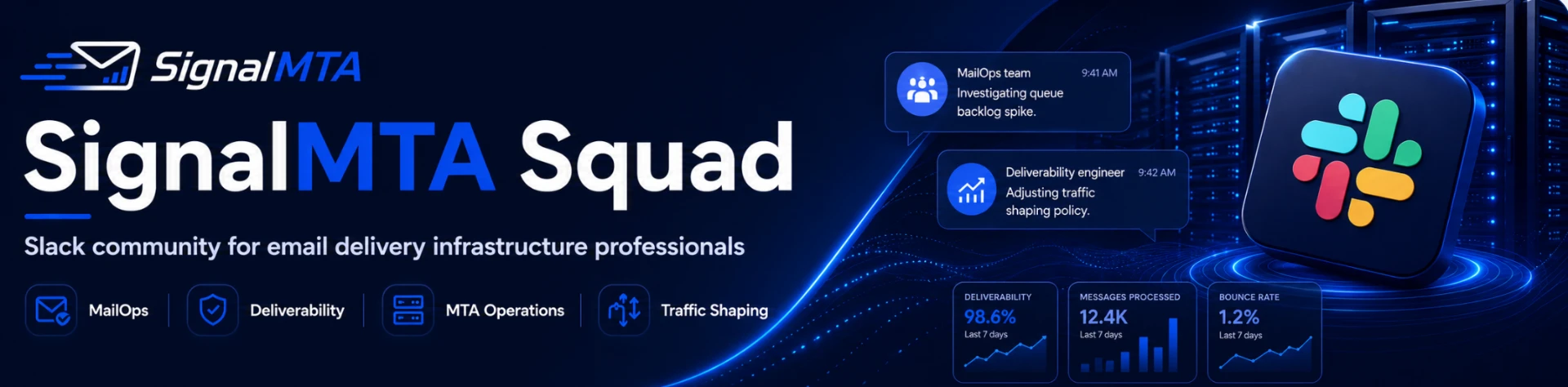
A Slack community for email delivery infrastructure professionals — MailOps engineers, deliverability leads, and platform teams comparing notes on queue behavior, provider throttles, warm-up strategy, and traffic shaping in the real world.
- MailOps
- Deliverability
- MTA Operations
- Traffic Shaping
Invites are issued to verified delivery practitioners during the pre-release program.
From the blog
Migration guides and sending strategy.
Practical write-ups for operators evaluating self-hosted SMTP infrastructure and moving off legacy MTAs.
Self-Hosted MTA vs. Managed SMTP: Cost & Control
How instance-based, self-hosted SMTP software compares to per-message managed services on predictability, control, and operational effort.
Read articleMigrating from PowerMTA to SignalMTA
Map legacy PowerMTA virtualMTAs, pools, and XML traffic shaping into SignalMTA routes, pools, and scripting hooks.
Read articleIs Open Source Really Free?
Why serious senders should weigh hidden labor, support, security, and opportunity costs before choosing an open-source MTA.
Read articleSo You Want to License Your MTA by Volume…
Why per-message MTA licensing creates unpredictable costs, budget variance, and perverse incentives for high-volume senders.
Read articleFAQ
Questions serious teams usually ask first.
CTO questions
CISO questions
MailOps questions
Deliverability questions
Are You Ready to Get Serious?
Discuss your delivery footprint, secure preferred Cadre licensing, and help shape the next generation of high-performance email delivery software.
No spam. Product updates and evaluation coordination only.